
—and why it matters more now than ever
I still remember the kind of board meeting that looks perfectly normal from the outside.
A full agenda. A polished deck. “Clear” recommendations. The familiar comfort of numbers that appear to tell a story.
And yet, inside the room, something didn’t add up—not because the analysis was weak, but because two highly capable people, looking at the same information, reached opposite conclusions with equal conviction.
What we were really debating wasn’t the spreadsheet.
It was the trade-off.
By trade-off, I mean the real choice hiding beneath the technical language: the moment when two legitimate priorities pull in different directions—and you can’t fully satisfy both. You can’t “solve” it with one more slide. You have to choose what you will prioritise, what you will accept as a cost, and what you will still be accountable for when the context changes.
In boardrooms, trade-offs show up in very recognisable forms—like these:
Approve now to seize the moment—or pause for proper oversight. Expand into a new market—or stay focused on the core. Push for growth—or protect the mission from dilution. Offer full flexibility to attract talent—or insist on enough togetherness to keep culture alive. Cut costs this year—or keep investing in resilience you hope you won’t need.
Both sides were reasonable. That’s what made it hard.
That evening quietly shifted something in me. I’ve been in these rooms since 2009, and I’ve learned to pay attention when a decision looks “obvious.” Often, that confidence is precisely where the hidden tension lives.
Because the most consequential decisions are rarely “right vs wrong.” They are choices where you’re deciding what to prioritise, what to accept as a cost, and what you will still be accountable for when the context changes.
And that is where governance becomes real.
The baseline of any board decision
This isn’t about what I personally “won’t compromise on.” It’s simply the baseline of corporate governance—regardless of sector, regardless of whether the environment is mission-critical:
compliance, effective oversight, and fiduciary duty.
Boards operate within legal duties, supervisory expectations, and clear lines of accountability. You can’t “innovate” your way out of the basics. You can’t outsource responsibility to a model, a consultant, or a process. The baseline must be defensible.
But once that baseline is secured, a deeper problem remains:
How do we make decisions under uncertainty—quickly enough to stay relevant, carefully enough to stay responsible, and coherently enough to remain defensible over time?
Why I created AIRIS
I created AIRIS because I kept seeing the same pattern.
Not a lack of intelligence. Not a lack of data.
A collapse of decision quality under pressure.
It happens in predictable ways:
- We narrow the frame too quickly to what is measurable and immediate.
- We argue about numbers when we’re actually arguing about risk tolerance, legitimacy, or time horizons.
- We treat trade-offs as something to hide—because naming them feels uncomfortable.
- We mistake confidence (or AI fluency) for truth.
- We diffuse accountability until no one truly owns the consequences end-to-end.
And then we call it “alignment” when it’s really just exhaustion.
AIRIS is my response to that problem: a simple way to protect judgment when uncertainty is high, time is compressed, narratives are contested, and the downstream effects of decisions are harder to reverse.
AIRIS is also informed by a broad body of work on decision-making and judgment under uncertainty—alongside interviews and conversations with board members and senior leaders. Again and again, the same lesson comes back: good judgment is rarely a personality trait. It’s a discipline. It can be strengthened. And it benefits from structure when stakes are high.
Why this problem is getting harder now
Uncertainty has always existed. What has changed is the speed.
AI is accelerating how fast organisations can automate, optimise, generate, and scale decisions. The deeper shift is that it compresses the distance between intent and consequence: choices that once took months to ripple through a system can now reshape operations, work, and stakeholder trust in weeks.
When decisions scale faster, the cost of poor judgment rises.
And when outputs become fluent, the temptation is subtle but powerful: to step back from judgment, to let the system’s confidence become our confidence, and to let accountability blur.
This is why the idea of being “good ancestors” has started to feel less like an inspiring phrase and more like a governance discipline.
If our decisions have greater downstream impact than before, then strengthening decision quality isn’t optional. It’s stewardship.
Being a good ancestor doesn’t mean being slow, soft, or naïve. It means being rigorous about consequences, honest about incentives, and explicit about the values shaping the trade-off.
It means asking:
What future are we writing with this decision—and what future are we quietly closing?
The issue AIRIS is trying to solve (in plain words)
AIRIS exists to solve one practical problem:
How do we make “complete” decisions under uncertainty—decisions we can stand behind today, and still defend when the context changes?
“Complete” doesn’t mean perfect. It means the decision has been examined through the essential lenses that prevent predictable failure:
- Are we being honest about the future we’re betting on?
- Are we stuck in a false binary?
- Are we building something robust—or something fragile?
- Is accountability real—or performative?
- Are we creating durable value—or borrowing from the future to pay for the present?
That is what AIRIS is for.
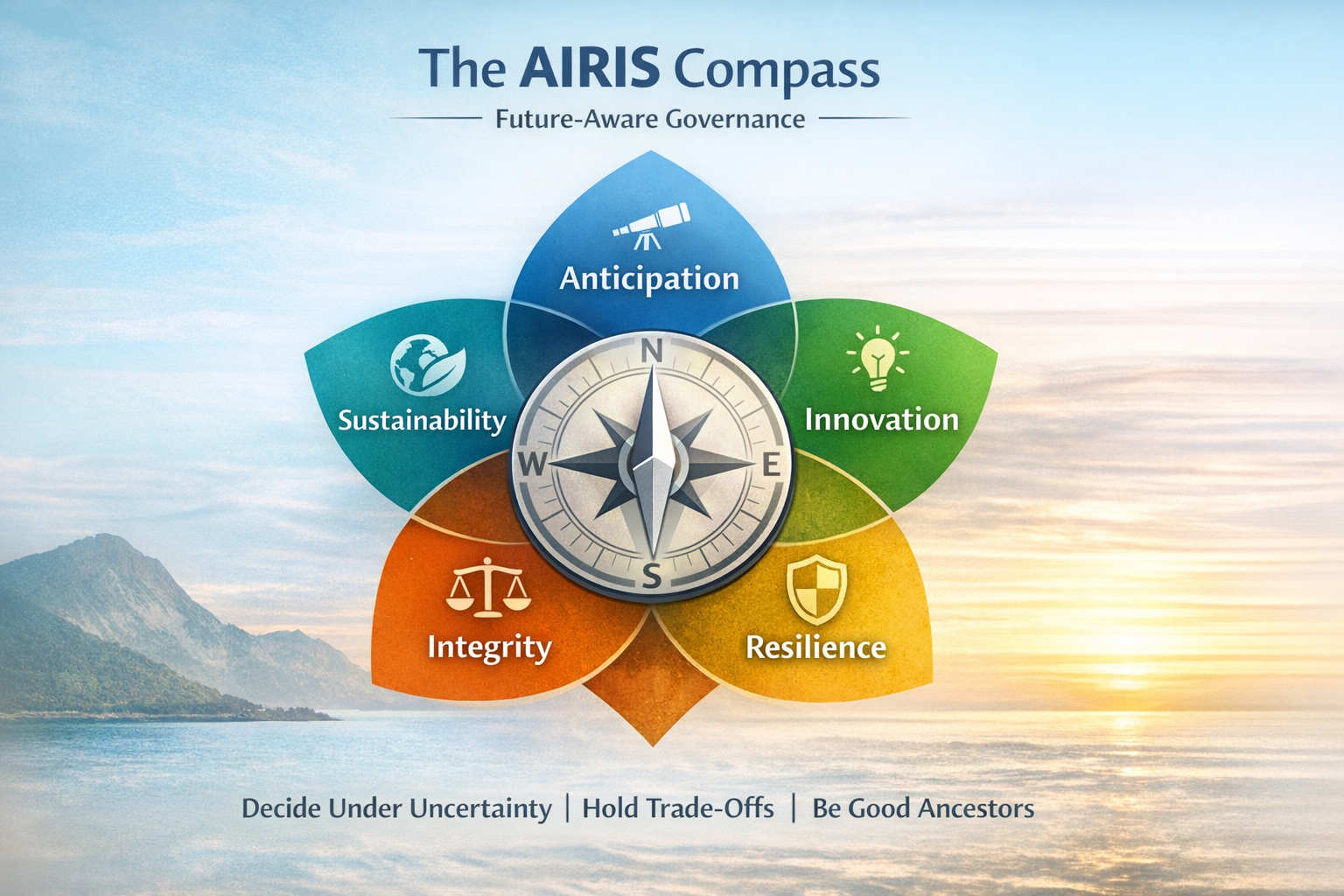
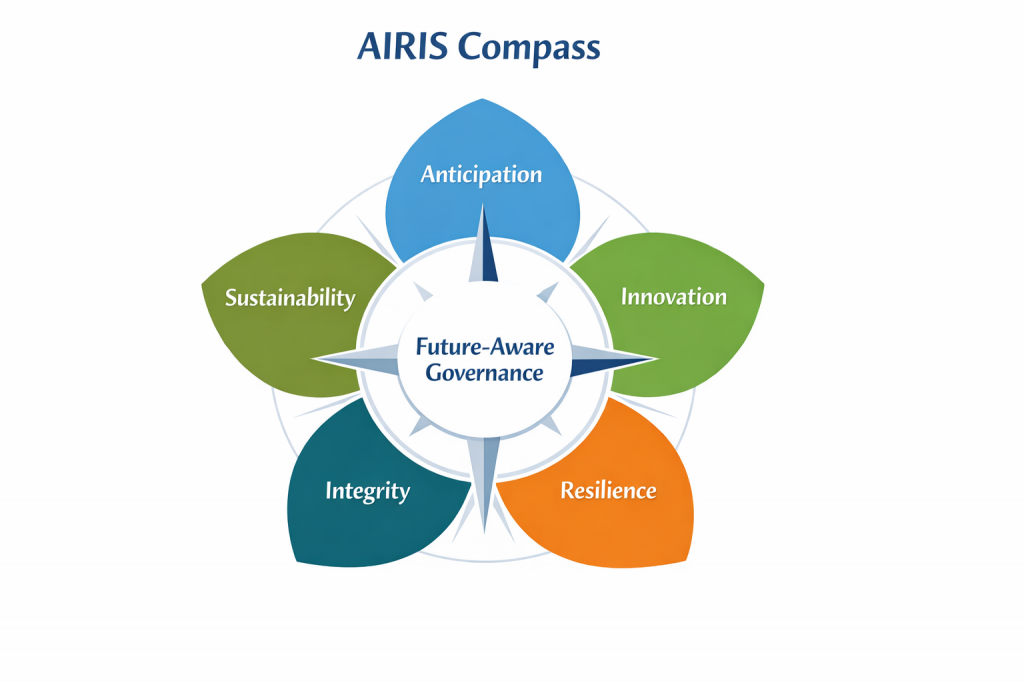
The AIRIS Compass: five lenses that strengthen discernment
I use the AIRIS Compass as a practical way to reflect and discern trade-offs—especially when the room feels tense, time is short, and the decision is being presented as “obvious.”
A — Anticipation
Not just “what could go wrong,” but: what future are we creating?
- What future are we trying to make true with this decision?
- If we succeed, what becomes possible?
- What early signals would tell us we’re on the right path?
I — Innovation
Trade-offs feel impossible when we treat them as binaries.
- Are we choosing between A and B too quickly?
- What credible third path exists (phased, conditional, reversible)?
- What small experiment can reduce regret before we scale?
R — Resilience
This is where we test fragility.
- What has to go right for this to work?
- What breaks first if conditions change?
- Can we absorb the downside if we’re wrong?
I — Integrity
The governance core: ownership and defensibility.
- Who owns the judgment—and who owns the consequences?
- Where could accountability blur (especially with AI in the loop)?
- Can we explain this decision clearly to stakeholders we respect?
S — Sustainability
The long view, made practical.
- What value endures beyond the quarter?
- What are we eroding quietly while we optimise the visible metric?
- Are we strengthening legitimacy—or spending it for short-term certainty?
AIRIS doesn’t eliminate tension. It makes it speakable.
And once the trade-off is speakable, decision-making becomes more adult: clearer, calmer, more accountable.
My motivation, simply put
I built AIRIS because I believe governance is one of the most powerful ways the future gets written.
Not through speeches. Through ordinary decisions made in ordinary rooms—when people are tired, incentives are loud, and certainty is tempting.
And I’ve watched trust get spent in small, reasonable steps—until one day you realise it’s gone.
AIRIS is my attempt to hold a line:
to make decisions that are not only smart, but defensible;
not only fast, but responsible;
not only successful today, but worthy of tomorrow.
If that resonates with you—if you sit in decision rooms where the stakes are real and the trade-offs are hard—welcome.
This is what AIRIS is for.
How this space will evolve
AIRIS will grow through three kinds of writing:
- Compass essays — one principle at a time, grounded in practice.
- Decision tools — short frameworks that can be used in real meetings: decision thresholds, reversibility, pre-mortems, red-teaming, incentive mapping, stakeholder legitimacy checks.
- Governance dilemmas — the tensions that appear repeatedly in boardrooms and institutions: speed vs deliberation, metrics vs culture, AI efficiency vs accountability, transparency vs strategic confidentiality, innovation vs operational risk, short-term performance vs long-term legitimacy.
The aim is not to provide perfect answers. It is to improve the quality of the questions we can hold—and the discipline with which we decide.
Because governance is not a separate layer above reality. It is one of the most powerful ways reality is shaped.
If you collaborate with influential institutions and care deeply about how today’s choices shape tomorrow’s world, welcome. AIRIS invites you to create governance that is both rigorous and compassionate, rooted in complexity, and focused on the future we are already stepping into.