
There is a difference between being realistic and letting risk run the whole conversation. Right now, many future narratives blur that line.
We talk—often correctly—about what could go wrong: AI disruption, climate instability, institutional fragility, job displacement. The risks are real, and ignoring them would be irresponsible. And yet, when risk becomes the only frame, something subtle happens. The future starts to feel smaller. We get better at diagnosis, but weaker at direction. We can list threats in detail, but we struggle to name what we want to build.
For me, the effect is quiet but noticeable. Even as someone naturally optimistic, risk-only narratives can drain energy. They narrow agency. They make bold action feel less imaginable.
That’s why, during a foresight training I’m currently taking, I found myself rereading Fred Polak. His book The Image of the Future offers a sharp lens for this moment: societies don’t only struggle because of external shocks—they also weaken when their shared images of the future lose vitality.
What Polak meant by “images of the future”
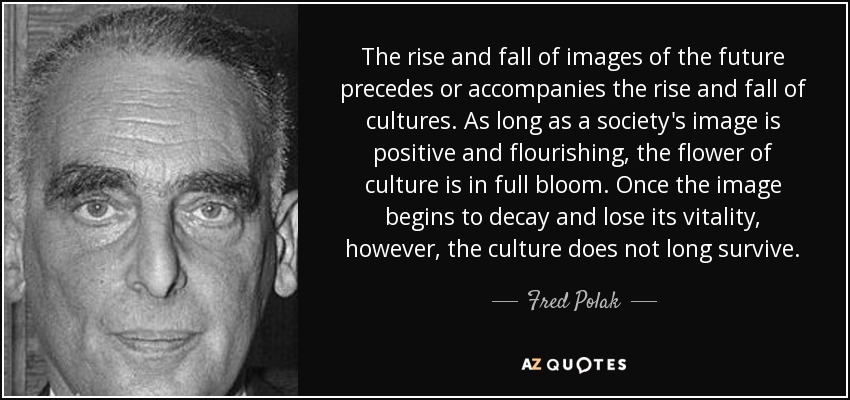
Polak’s core idea is simple. The futures a society holds in its mind shape what it can do in the present.
When those images are alive—credible and motivating—they mobilise long-term behaviour. For example: investment, innovation, cooperation, and institutional redesign. When those images fade, something deeper than optimism disappears. Orientation fades too.
Importantly, this is not about “positive thinking.” Polak is not asking us to cover hard realities with cheerful slogans. Instead, he points to a structural dynamic: images of the future are practical forces. They shape what a culture treats as realistic. They also shape what it funds, regulates, postpones, or accepts as inevitable.
How images become behaviour
Polak’s deeper point goes one step further. Images don’t stay in the realm of ideas. Over time, they influence behaviour.
A shared future-image shapes expectations. It also shapes what people consider “worth it.” As a result, it affects how much effort they are willing to invest. In that sense, future-images can reinforce themselves. If decline is the default, time horizons shrink. Renewal gets underfunded. Stagnation then becomes more likely.
By contrast, when a society can hold a compelling and credible future, it tends to build capability. It attracts talent. It also takes smarter risks and strengthens institutions.
Why risk-only narratives reduce agency
Of course, a culture can be accurate about risk and still become trapped by it.
When dystopian narratives dominate—algorithmic control, climate collapse, social fragmentation—risk becomes the whole story. Once that happens, the emotional climate changes. Decisions become more defensive. Time horizons get shorter. People focus on optimising the current system rather than redesigning it.
Eventually, the future starts to feel like something that happens to us, not something we can shape.
This is where Polak becomes especially useful. He helps name the pattern. The collective image loses vitality. Collective agency then drops with it. And because decisions follow imagination, shrinking the imagined future shrinks the range of action.
The paradox: maximum capability, minimum imagination
Here is the paradox. We have unprecedented technological capacity. Yet we also face a striking poverty of future imagination.
AI, biotechnology, and climate transition are reshaping the conditions of human life at extraordinary speed. Meanwhile, public narratives often swing between two extremes. Either catastrophe is inevitable, or technology will magically save us. In different ways, both positions can become forms of abdication. One ends in fatalism. The other ends in wishful thinking. Neither builds capability.
That’s why, as complexity rises, we need futures that are not only preferable. They must also be plausible. In other words, they must support serious decisions—not just emotions.
What this means for governance: future-images shape what gets funded
Polak wasn’t analysing corporate boards as such. He was analysing societies. Even so, in governance terms his point is highly practical. The future an institution carries shapes its priorities. It also shapes time horizons. Finally, it shapes what gets legitimised as “responsible” decision-making.
In practice, future-images shape:
- what boards treat as strategic vs. peripheral,
- what risks get prioritised (and which opportunities get dismissed as unrealistic),
- where capital goes (resilience vs. extraction),
- what time horizons are considered legitimate,
- and what trade-offs are treated as unavoidable.
Put simply, a board can have excellent metrics and still drift. That happens when its implicit image of the future is broken. The organisation may look rational on paper. Yet it can lose the inner capacity to move.
A practical tool: the Future Image Audit (30–45 minutes)
So the practical question is clear: how do we rebuild imagination without slipping into naïve optimism?
Here is a simple audit you can run with a team—or in a board setting:
1) Name the default image (10 minutes)
First, ask: “When we talk about the future, what storyline dominates?” Then write it in one sentence.
2) Identify what it causes (10 minutes)
Next, ask: “What does this image make us do?” For example: postpone investment, increase control, avoid experimentation, underinvest in learning.
3) Create two alternatives (10 minutes)
Then draft:
- one preferable-but-plausible future, and
- one hard-but-plausible future.
Keep each as 3–5 bullet points.
4) Translate into decisions (10–15 minutes)
Finally, for the preferable-but-plausible future, choose:
- one investment to make,
- one governance move (oversight, KPI, incentives, policy), and
- one capability to build (skills, partnerships, data, ethics).
At that point, imagination becomes strategy.
Returning to Polak
In the end, if Polak is right—and it becomes harder to dismiss him the more our world accelerates—then the key question shifts. It is not only what technologies are arriving. It is also what images of the future we keep reinforcing as they do.
Because a shared image of the future is not decoration. It is an organising force. It shapes what we dare to fund. It also shapes what we postpone and what we label “realistic.” Finally, it shapes what we quietly accept as inevitable.
So the real risk today may not be external collapse. It may be an internal one: the slow starvation of social imagination. The response is not optimism. Instead, it is something more demanding: the deliberate construction of futures that are credible, shareable, and actionable.
And if we invest according to what we carry in our heads, then reclaiming our capacity to imagine is not a luxury. It is a responsibility.
Key takeaways
- Societies rise or fall with the vitality of their shared images of the future.
- Risk-only narratives don’t just inform; they can quietly reduce agency and ambition.
- Future-images shape what institutions treat as realistic, urgent, and worth funding.
- Preferable futures require disciplined practice—not naïve optimism.
Further reading
- Fred Polak — The Image of the Future
- Kenneth Boulding — The Image: Knowledge in Life and Society (Google Books record)
- UNESCO — Futures Literacy (why futures capability matters)
- UK Government Office for Science — Futures thinking / foresight guide
- OECD — Strategic Foresight programme overview
Other related AIRIS articles
- The Decision Problem AIRIS Was Born to Solve
- Cómo difundir la prospectiva estratégica en toda la organización: De la visión del Consejo a la acción en primera línea
- All post on Anticipación