
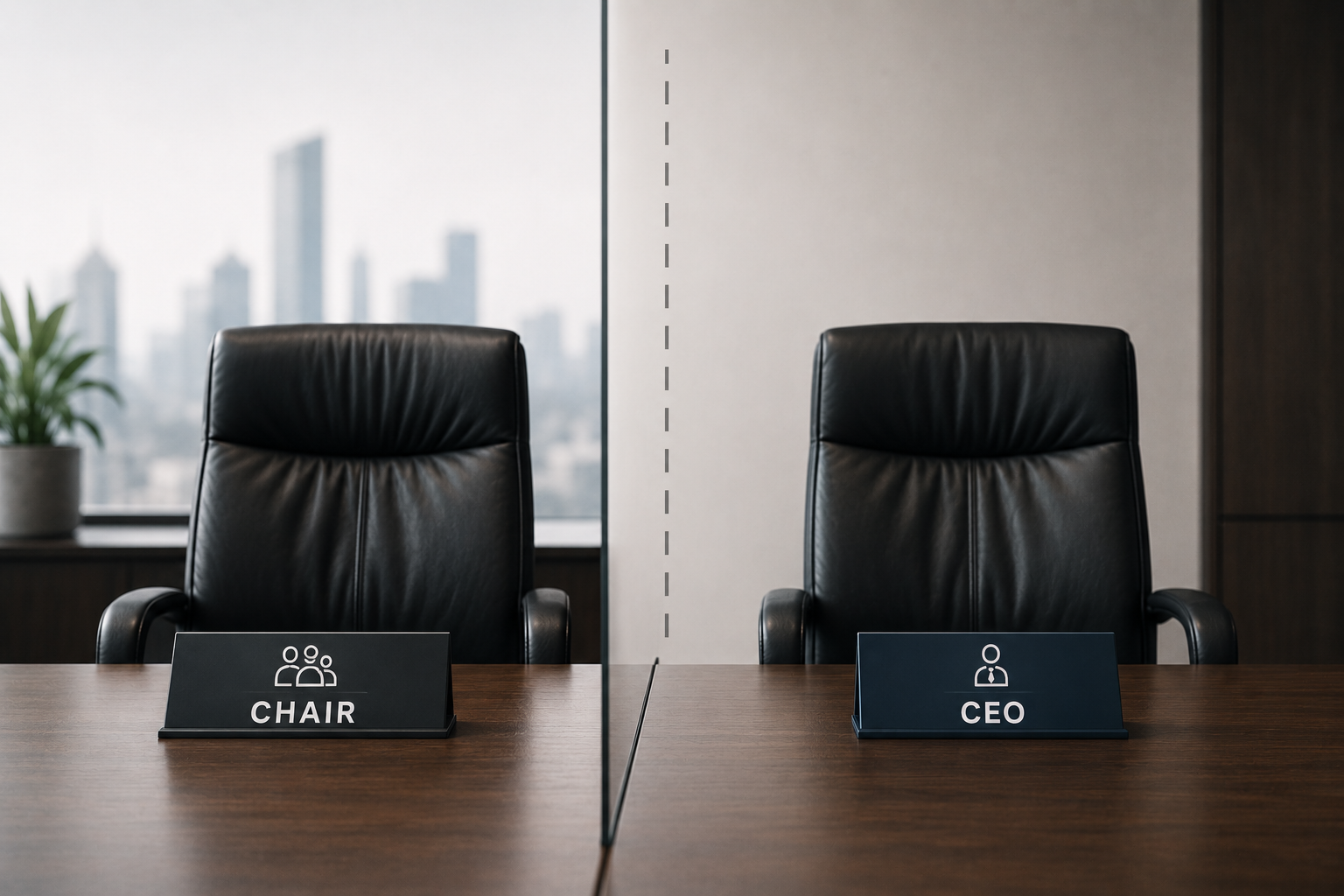
Why the codes of good governance have recommended it for three decades, what has happened in Spain, and why the best argument has to do with how a board thinks.
A story that begins with three scandals
The principles of good governance that we take for granted today were forged in the wake of crisis. In the late 1980s, three companies shook the City of London within a few months of each other. Polly Peck, a textiles and electronics group that had been one of the FTSE’s bright stars, collapsed in 1990 amid fraud allegations against its charismatic founder and executive chairman. The Bank of Credit and Commerce International (BCCI) went under in 1991, leaving a multi-billion-pound hole and an international money-laundering scheme behind it. That same year Robert Maxwell — chairman and CEO of the Mirror Group — vanished overboard in circumstances that have never been fully explained. After his death, it emerged that he had looted £440 million from his employees’ pension funds.
Three very different companies, but the same structural pattern: a single person held the executive power and controlled the body meant to oversee them.
The response came in 1992 with the Cadbury Report, drafted by a committee chaired by Sir Adrian Cadbury at the request of the Financial Reporting Council, the London Stock Exchange and the auditing profession. The report set out clearly, for the first time, a principle that today seems obvious: there should be a clear division of responsibilities at the top of a company, and the position of Chair of the Board should be separate from that of Chief Executive Officer. Its concern, in its own words, was to prevent any one person from holding “unfettered powers”.
From Cadbury, directly or indirectly, the modern codes of good governance descend. Its recommendations were adopted as a voluntary code under the “comply or explain” principle, a model that, thirty years on, remains the backbone of good governance in Europe.
The European map
The European picture is strikingly coherent. A survey by Accountancy Europe covering 17 European countries finds that thirteen of them now separate the roles of Chair and CEO as standard practice.
The UK Corporate Governance Code 2024, which applies to accounting periods starting on or after 1 January 2025, devotes an entire section to the Division of Responsibilities. The Swiss Code of Best Practice recommends separation in its article 18. The codes of France (AFEP-MEDEF), the Netherlands, Italy, Belgium and the Nordic countries all point in the same direction. Germany and Austria go further: their mandatory two-tier system, with its Vorstand and Aufsichtsrat, makes it structurally impossible for the same person to hold both positions.
Beyond Europe, South Africa’s King IV code, Australia’s ASX Principles and the codes of Singapore, Hong Kong and Canada also recommend separation. The notable exception remains the United States, where dual roles were the norm for decades. Even there, the trend has reversed: in 2025, 46% of Russell 3000 companies had an independent chair, against 34% where the CEO chaired the Board.
Spain: three decades of evolution
Spain has been far from a bystander in this movement. If anything, it has been one of the European countries with the most sustained record of building its own body of corporate governance practice, inspired by Cadbury but shaped by the particularities of its market and its business fabric.
The Olivencia Report (1998) was the first Spanish code of its kind. It was followed by the Aldama Report (2003) and the Conthe Code (2006), each refining recommendations on board composition, independence and oversight. In 2015, the CNMV (Spain’s securities regulator) issued the Good Governance Code for Listed Companies, known as the Rodriguez Code, revised in 2020 to incorporate considerations of sustainability, diversity and digitalisation.
The current Code explicitly recommends separating the roles of Chair and CEO, and operates under the “comply or explain” principle: it does not impose separation, but it requires companies that do not separate to justify their decision. It also provides for the figure of the Lead Independent Director (Consejero Coordinador Independiente), set out in article 529 sexies of the Spanish Companies Act. This figure is mandatory when the Chair and CEO are the same person, and is increasingly appointed on a voluntary basis even where the roles are already separate, as an extra layer of governance. It has functional equivalents in the British Senior Independent Director and the French administrateur referent. It deserves an article of its own, though, so I will come back to it another day.
It is worth noting that the Code is currently under review. The CNMV announced in November 2025 the start of a reform expected to culminate in a new text in 2027. The stated priorities include sustainability, cybersecurity and the use of artificial intelligence in boardrooms, a useful indicator of how the agenda of issues that boards must think about is shifting.
What has actually happened in practice? The evolution of the IBEX 35 (Spain’s blue-chip index) is telling. Two decades ago, an executive chair with full powers was the norm in Spain’s large listed companies. Today the picture has reversed, and the great majority of IBEX 35 companies have separated functions. According to press coverage from early 2025, the number of index companies in which a single person concentrates all executive power has shrunk to a handful. One recent example captures the dynamic well. Sacyr, for years a company with a concentrated executive chairmanship, announced in January 2025 the appointment of a CEO, leaving its chair with more narrowly defined executive duties. The stated reason was to improve “the quality of governance”.
Alongside this regulatory dynamic, a further force has become increasingly decisive: the institutional investors and the proxy advisors. Glass Lewis holds that separation creates a more independent and stronger governance structure. ISS, BlackRock, Vanguard and State Street have built similar considerations into their voting guidelines. For a European listed company, presenting separated roles is now a quality signal that the market notices and, increasingly, rewards.
The case for separation
From the most familiar argument to the one that matters most.
- Independent oversight. A board exists to supervise the executive on behalf of shareholders and other stakeholders. When the person who leads the executive team is also the one who calls board meetings, sets the agenda and chairs the debate, supervision is structurally weakened. The issue is not bad faith but institutional physics: no one can be both judge and party without something giving way.
- Different jobs. Being a CEO and chairing a board are different jobs. They call for different temperaments, different time horizons and different ways of relating to people. The CEO executes, prioritises, decides quickly and is accountable for results. The Chair tends to the dynamic of the board, the quality of debate, succession, and the relationship with shareholders. Mixing them usually means that one of the two roles is poorly attended to, and it tends to be the Chair’s, because operational urgency always eats into the space reserved for reflection.
- Resilience and succession. When an executive crisis breaks, a board with a separate chairmanship absorbs the impact without losing its head at the same time. Succession, both of the CEO and of the Chair, is also planned with more perspective when the roles are not concentrated in one person.
And then there is the argument that is rarely made, and that, to my mind, is the most important of all.
- The quality of the board’s thinking. The essential function of a board is not to execute, nor even to supervise in the strictest sense. It is to think well about the decisions that no other body in the company can think about with the same perspective: the ones played out over long horizons, the ones that involve enduring trade-offs, the ones that require weighing what does not show up in the dashboard. And thinking well has structural conditions.
When the same person leads execution and chairs the body that is supposed to deliberate on it, the deliberation is compromised before it begins. Someone who has spent the quarter defending a strategy to their team, the analysts and their employees can hardly turn around, in the boardroom, and question it with full freedom of mind. Confirmation bias, public commitment, the fatigue of having to justify a position: mechanisms that cognitive psychology has documented over decades, and that exert their pull.
A competent non-executive Chair designs the conditions for the board to think. They build agendas that go beyond the reporting cycle. They make room for the topics that matter five years out. They ensure that quieter voices are heard, that dissent is welcome, that decisions are made after deliberation rather than before. They look after the emotional temperature of the room, and they cultivate the trust that allows uncomfortable questions to be asked.
This is not a secondary soft skill. It is what separates a board that adds value from one that simply ticks the boxes. And it is structurally harder, though not impossible, when the person in the Chair is the same person running the company.
Getting it right: what it takes to make separation work
It would be dishonest to present separation as a solution that runs itself. Done badly, it can create real risks: ambiguity about who is leading when the roles are not clearly delineated; personal friction between Chair and CEO if the relationship lacks mature professional trust; slower decision-making when speed matters most; and the possibility that a weak, passive or overly interventionist non-executive Chair ends up producing worse governance than a well-managed dual structure. None of these is a reason not to separate. They are reasons to take seriously how it is done.
There are no perfect recipes. Every board has its own history, every company its own shareholder structure, its own sector, its own moment. But there are some things worth keeping in mind if the separation is to deliver on its promise.
- The first is to formalise the roles in writing, in the board’s internal rules, in the job descriptions, in the internal protocols. Separation calls for clarity about who represents the company, who speaks to which shareholders, who leads in a public crisis. Without that clarity, separation produces ambiguity rather than balance.
- The second is to look after the Chair and CEO relationship. These are the two most visible figures in the company. I have seen, in my years on boards, how a strained relationship between them can consume more strategic energy than any external disruption. The structure only works if the people inhabiting it respect each other professionally and operate in mutual trust.
- The third is to choose the Chair well. Separation creates the conditions for quality to emerge, but it does not guarantee it. The selection, the dedication and the professional standing of the non-executive Chair are decisive. A good Chair is worth more than any organisation chart.
- And finally, clear protocols for the moments when speed matters. Corporate operations, crises, urgent decisions. If Chair and CEO have not thought through in advance how to coordinate in those moments, the separation can become a drag at precisely the times when agility counts.
All these conditions, when you look closely, point to the same idea. Separation is a necessary condition for good governance, but not a sufficient one. It is the foundation, not the building. What is built on top depends on the people, the formalisation and the culture of the board.
In closing
Codes can recommend. Investors can vote. Proxy advisors can align. But the separation of Chair and CEO only works when it is understood for what it is: not a compliance exercise, but a deliberate choice about how the most important decisions ought to be made.
The underlying question is always the same. Under what architecture does this board think best?
The answer, in the great majority of cases, is to separate, and, above all, to take care of what comes next.
Published at airis.org. AIRIS is a governance framework for boards in an age of complexity, built around five principles: Anticipation, Innovation, Resilience, Integrity, and Sustainability.