
Leaders often imagine moral dilemmas in governance as rare, high-stakes moments—the whistleblower who forces a reckoning, the crisis decision taken under public scrutiny, the lone voice in the boardroom that breaks the silence. Yet most moral dilemmas in governance are quieter and far more frequent. They unfold week after week in decisions about what to disclose, whom to protect, and which value to place first when not all of them can be honoured at once.
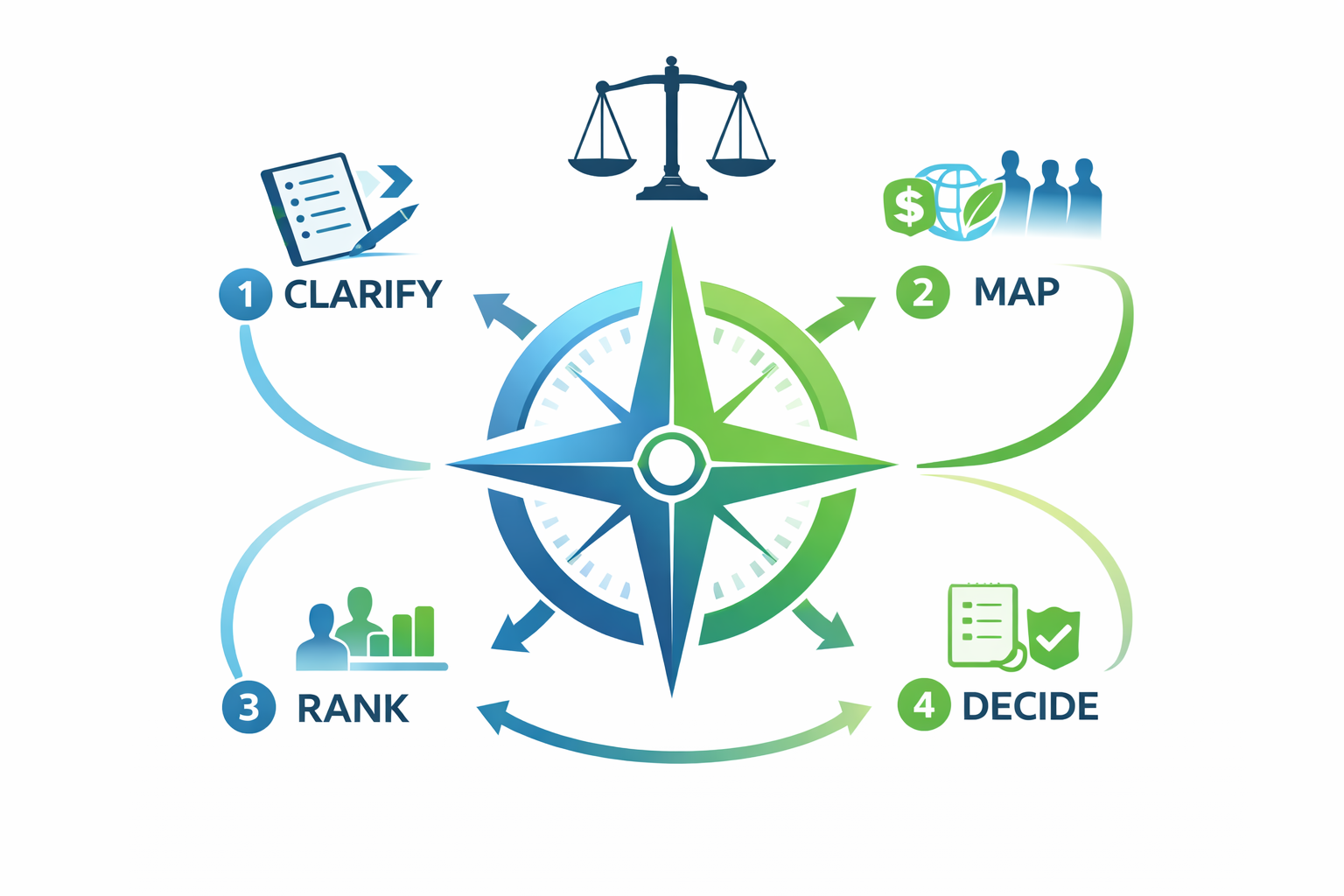
It is precisely because these dilemmas are subtle, recurring and politically charged that leaders need more than intuition or experience alone. They need a shared, disciplined way to recognise a moral dilemma, surface the real options, weigh competing values and explain their choices. The four-step framework that follows is designed to do exactly that.
What makes something a moral dilemma?
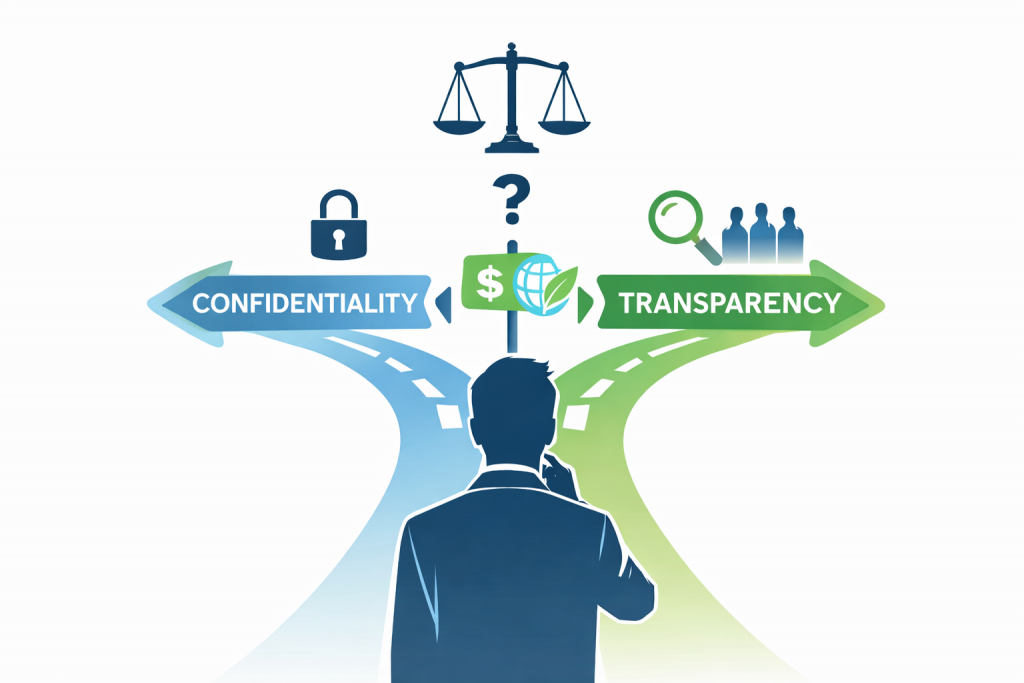
A situation qualifies as a moral dilemma when at least three conditions hold.
• You must choose: inaction is also a decision with consequences.
•At least two options are open, each grounded in recognisable moral reasons, not just personal preference.
•No option allows you to preserve all the important values at stake; choosing one value means sacrificing another.
In governance settings this might look like protecting an employee’s confidentiality vs. informing the board, safeguarding a client relationship vs. reporting a questionable practice, or delivering on a financial target vs. honouring a commitment to safety or sustainability.
Research on political and administrative ethics shows that such “dirty hands” situations are not exceptions but structural features of roles where power, responsibility and competing values intersect. The question is not whether dilemmas arise, but whether leaders have a reliable way to recognise and process them.
A four‑step framework for ethical decisions
Ethicists and practitioners have developed many multi‑step models for ethical decision‑making, which typically include identifying the issue, gathering facts, considering stakeholders, generating options and testing them against principles. The following four‑step framework distils those ideas into a format tailored to boards and senior leadership.
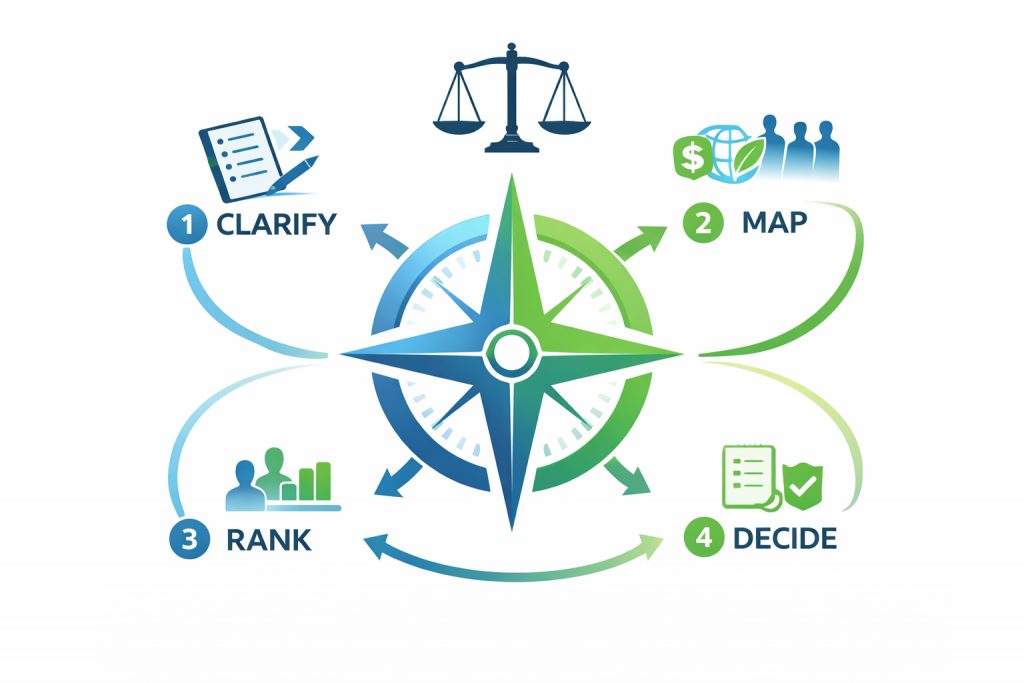
Step 1 – Clarify the dilemma and surface the option
Start with a short, neutral description of the situation and the two main options that create the tension. Avoid moral labels at this stage; describe what is happening, what each option involves, and who is affected.
Then deliberately go beyond the binary and ask: “Are there alternative courses of action we are not seeing?” Many established models emphasise the importance of generating multiple options before evaluating any of them. In practice, this can include phased disclosure, conditional commitments, independent reviews, or changes in timing and scope.
You are not looking for a perfect compromise that abolishes the dilemma; you are trying to avoid being trapped in a false choice between two poorly designed options.
Guiding questions:
• What are the two core options that create the conflict?
• What other realistic options could we consider (changes in scope, timing, process, stakeholders)?
• What would “doing nothing” concretely mean here?
Step 2 – Map consequences, stakeholders and reasons
Next, resist the temptation to argue only for the option you intuitively prefer. Systematic models ask leaders to identify stakeholders, likely consequences and the ethical dimensions of each option before deciding.
There are two main families of reasons you should articulate for each serious option:
• Consequences: What short‑ and long‑term effects will this option have on each stakeholder group? Who benefits, who is harmed, and in what ways?
• Principles and values: Which norms, commitments or values does this option honour (e.g., transparency, loyalty, justice, privacy, non‑maleficence, stewardship)?
For each of the two main options, list at least three or four serious reasons—ideally a mix of consequences and principles.
Guiding questions:
• If I had to defend this option in front of a critical but fair audience, what would I say?
• What concrete good does this option protect or promote?
• Which professional standards, codes or commitments does it align with?
• How might this decision influence trust in leadership over time?
Step 3 – Rank the values in conflict
Once you have robust arguments for each option, you can see more clearly which values are in tension. Moral dilemmas rarely arise from a clash between “good” and “evil”; they arise from collisions between legitimate values that cannot all be fully realised at once.
In boards and executive teams, typical value conflicts include for example:
- Transparency versus confidentiality, highlighting the delicate balance between openness and privacy.
- Loyalty versus fairness, emphasizing the challenge of remaining faithful while ensuring equitable treatment.
- Autonomy versus protection, focusing on the tension between individual independence and safeguarding.
- Short‑term security versus long‑term sustainability, considering immediate safety needs against future viability.
- Obedience to rules versus responsiveness to human context, weighing strict adherence to regulations against the need for empathetic understanding.
Guiding questions:
• What are the two or three most important values at stake here?
• Which of them is non‑negotiable in this case—and why?
• What does our mission, or our role as stewards, require us to prioritise?
• How will this choice shape the culture and trust in leadership?
List the values each option protects and those it sacrifices. Then make the uncomfortable move of ranking them for this case. Ethical leadership guides stress that clarifying value priorities—anchored in the organisation’s mission, code of ethics and stakeholder commitments—helps prevent ad‑hoc or purely political trade‑offs.
Step 4 – Decide, own the trade‑offs, and explain your reasoning
The final step is not to invent a clever “middle way” that dissolves the conflict, but to choose one of the serious options and accept its costs. Ethical decision‑making frameworks for leaders agree that a responsible decision is one you can explain to those affected, including those who disagree.
A practical discipline is to write a short justification memo, even if it remains internal:
• State the option you are choosing, concretely.
• Summarise the strongest arguments both for and against it.
• Explain why, in light of your value ranking, the reasons in favour outweigh the reasons against.
• Acknowledge foreseeable harms or disappointments and how you plan to mitigate them.
This kind of disciplined reflection does not guarantee that everyone will applaud your decision, but it makes it intelligible, principled and auditable—qualities repeatedly identified as critical to ethical governance and sustained trust in leadership.
Example: a governance moral dilemma in practice
Consider a board’s audit and risk committee that discovers a pattern of borderline practices in a profitable business line: nothing clearly illegal yet, but trends that could evolve into misconduct and reputational damage. Raising the issue publicly may unsettle investors and damage internal relationships, while staying silent protects the team in the short term but exposes the organisation and its stakeholders to larger risks later.
Applying the four‑step framework:
- Step 1 – Clarify options: escalate formally to the full board now; raise concerns privately with the business leader and request a corrective plan; commission an independent review through internal audit; or wait and monitor specific indicators.
- Step 2 – Map reasons: early escalation honours a duty of care to customers and the firm, may prevent larger harm, and aligns with risk and compliance commitments. Waiting preserves trust and avoids overreaction, but risks normalising questionable behaviour and eroding trust if the issue later becomes public.
- Step 3 – Rank values: loyalty to colleagues vs. responsibility to customers and the institution; short‑term stability vs. long‑term integrity; protection of current earnings vs. protection of reputation and licence to operate. Many governance experts argue that, for boards, integrity and stakeholder protection should carry greater weight than short‑term harmony.
- Step 4 – Decide and explain: the committee might choose to trigger an independent review, inform the chair and the board, and design a communication approach that is factual and fair. They could explain that, given their stewardship role, the duty to prevent potential harm and uphold integrity outweighs the discomfort of internal scrutiny and market nervousness.
Empirical work on trust in leaders suggests that choices which transparently prioritise impartial beneficence and long‑term fairness can strengthen trust, even when they involve tough trade‑offs. Conversely, decisions perceived as instrumental harm for the many, or as protecting insiders at the expense of others, tend to erode trust sharply.
Why this discipline matters for boards and executives
Boards of directors and senior leaders are repeatedly described as guardians of organisational integrity and sustainability, yet they operate under strong pressures for speed, consensus and performance. Ethical dilemmas are therefore not a niche concern but a daily reality wherever decisions allocate risk, opportunity and protection among stakeholders.
On one path, dilemmas are handled implicitly through power, habit and negotiation, which often yields inconsistent decisions and silent value trade‑offs. On another path, they are handled explicitly through shared reasoning, transparent frameworks and a willingness to own and explain trade‑offs.
Evidence from leadership and governance practice suggests that organisations which invest in explicit ethical decision processes benefit from more consistent decisions, deeper trust, faster learning from mistakes and cultures where people expect to justify their choices in terms of both outcomes and values. For boards, that is not only ethically desirable; it is a strategic asset in an environment where scrutiny, expectations and complexity are all rising.
Selected references
Baldwin, S. (2021). Ethics in Board Decision-Making.
Gallagher, C. (2024). Navigating Ethical Dilemmas in Leadership – A Roadmap to Integrity and Impact.
Nature Human Behaviour (2021). Moral dilemmas and trust in leaders during a global health crisis.
Michigan State University. Ethical Decision Making: A Six Step Process and Guide.
UK Government. The ethical decision-making model: caseworker guidance.
PMI Ethics Member Advisory Group. Leader’s Choice – Five Steps to Ethical Decision Making.
Aurora Training Advantage. Ethical Decision-Making Frameworks For Leaders.
Tassescore. Ethical Dilemmas faced by Members of the Board of Directors.
PMC. Administrative Ethics Conflict and Governance… (Frontiers in Psychology).