
How do we govern today for futures we cannot predict? The Case for Anticipatory Governance
I have been interested in the work of the Long Now Foundation for some time. Visiting The Interval in San Francisco, and standing next to a prototype of the Clock of the Long Now, brought me back to a deceptively simple question: are we looking far enough ahead?

The Clock is designed to keep time for 10,000 years, but its value goes far beyond the engineering feat. It’s a provocation about our relationship with time, and about what changes when we widen the horizon against which we evaluate our decisions.
No organization needs a 10,000-year strategic plan. But many of the systems through which we govern today encourage remarkably short horizons: quarterly results, annual budgets, electoral cycles, three or five year strategic plans. And many of the decisions taken within those horizons will have consequences lasting decades, sometimes generations. We are increasingly making long-term decisions inside short-term systems. That is not simply a planning problem. It’s a governance problem.
Different clocks, one system
One idea I keep coming back to is Stewart Brand’s concept of Pace Layers. Originally developed as a way of understanding how civilizations remain both adaptable and durable, it starts from a simple observation: complex systems don’t change at one speed. They contain different layers, operating at different rhythms and performing different functions. Brand identifies six: fashion, commerce, infrastructure, governance, culture and nature.
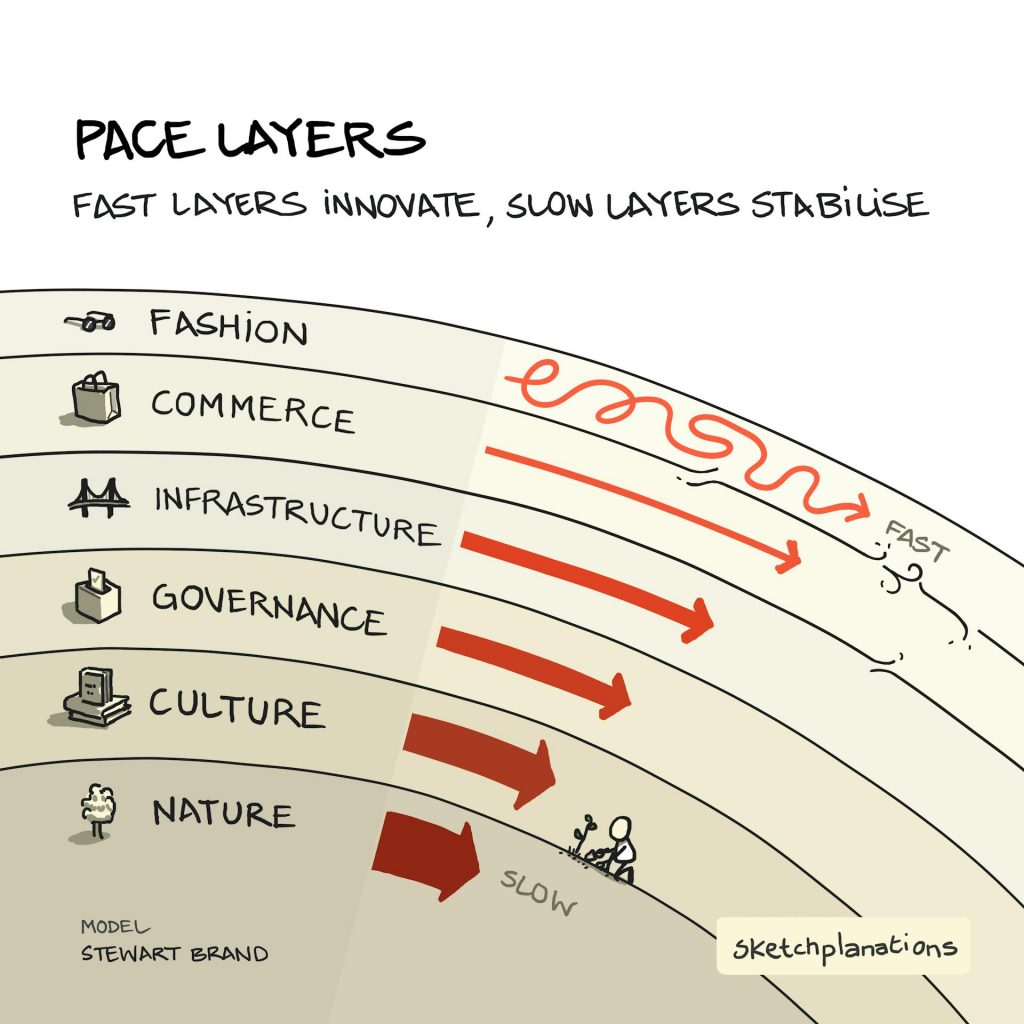
- At the top, fashion is the realm of rapid experimentation. The term extends well beyond clothing, it includes trends, ideas, behaviours and innovations that can emerge, spread and disappear extremely quickly, and much of what captures our attention sits here. The apparent disorder of this layer serves a purpose: many ideas fail, but some survive and eventually influence the layers beneath them.
- Commerce moves more slowly, turning some experiments into products, services, organizations, and business models. Markets adapt quickly to changes in preferences and opportunities, but because commerce works on short timelines, it cannot provide all the stability a society needs. Faster commercial cycles rely on slower institutions, rules, and infrastructure underneath them.
- Infrastructure moves on a very different clock. Physical systems, buildings, communications networks and other foundations of economic and social activity require large investments and can remain in place for decades. Brand extends the idea beyond physical assets too: education and science can also be understood as forms of intellectual infrastructure, whose benefits may be enormous but whose returns unfold over long periods of time. A society focused only on immediate payback risks underinvesting in precisely the foundations its future prosperity depends on.
- Then comes governance. Laws, institutions, regulation and systems of collective decision-making need to respond to change, but they also need to provide continuity. Governance mediates between faster forces above it and slower constraints below it, creating the conditions in which commerce and infrastructure can function while remaining anchored in deeper cultural expectations and natural limits. This matters because slowness, in this framework, isn’t necessarily institutional failure. It can be a feature rather than a defect. Institutions need time for deliberation, legitimacy, accountability and learning. The challenge is to remain responsive without becoming unstable.
- Below governance sits culture: language, values, norms, beliefs and shared understandings that often evolve over generations rather than years, providing societies with memory and meaning, and shaping what institutions can legitimately do.
- And underneath all of them is nature, operating across the longest horizons. Climate, ecosystems, geology and biological systems don’t follow corporate or political calendars. They establish boundaries within which every other layer ultimately operates, even when the faster layers temporarily behave as though those boundaries didn’t exist.
The power of Pace Layers, though, lies less in the six categories themselves than in the relationship between them. A healthy system doesn’t require all its layers to move at the same speed. It requires them to perform different roles. The faster layers generate variation, experimentation and learning, they react quickly when circumstances change and absorb some of the first impact of shocks. The slower layers provide continuity, memory and constraints, preventing the entire system from having to reinvent itself every time something changes at the surface. Brand captures this in a wonderfully concise line: “fast learns, slow remembers.”
There’s another implication I find equally important: the layers constrain and correct one another. The fast layers push new ideas downward. Some experiments eventually become businesses, some business innovations require new infrastructure, some technological and economic changes eventually force governance and culture to adapt. But influence also travels in the opposite direction. Governance constrains what commerce can do. Culture influences what governance can legitimately allow. Nature ultimately sets boundaries that none of the layers above can negotiate away. The result isn’t a hierarchy in which one layer controls the others. It’s a system of continuous feedback between different speeds, and that tension is part of what makes the whole thing resilient.
When the clocks fall out of sync
Seen this way, the governance challenge created by rapid technological change becomes more interesting. Technology can evolve in months. Markets can respond almost instantly. New business models can emerge and scale globally within a few years, while infrastructure, institutions, regulation, social norms and culture move at very different speeds. Artificial intelligence makes the contrast particularly visible: AI capabilities can change several times within the period required to draft legislation, redesign an organizational structure, adapt an education system or understand the deeper consequences of the technology. I explored what this means specifically for board practice in The AI-Augmented Boardroom.
The intuitive conclusion is that everything else needs to accelerate. But Pace Layers suggests something more nuanced: the problem isn’t that some layers are slow, they’re supposed to be. A society in which institutions, infrastructure and culture changed at the speed of technological fashion wouldn’t necessarily be more adaptive. It might simply become unstable.
Equally, though, slow layers can’t become immovable. If institutions can’t absorb learning from faster layers, governance becomes disconnected from the environment it’s supposed to govern. If infrastructure can’t adapt to structural change, it can lock societies into yesterday’s assumptions. If commerce ignores the constraints imposed by governance, culture or nature, short-term adaptation can generate long-term fragility. The challenge, then, lies in maintaining a productive relationship between different speeds, and in learning to see that relationship as normal rather than as a problem to be solved away.
That changes the governance question. Instead of asking how governance can move as fast as technology, we might ask how governance can remain stable enough to provide continuity while becoming adaptive enough to learn from a world changing much faster around it. That distinction matters. It means good governance requires more than speed. It requires the capacity to distinguish between what’s temporary and what’s structural, between signals that should be observed and changes that require action, between what should be allowed to evolve rapidly and what should deliberately remain slow. It also introduces a dimension conventional planning often underestimates: time itself becomes something we need to govern.
When considering an emerging change, leaders might ask which layer is changing, at what speed, and what’s driving it. Which other layers could eventually be affected, and how quickly can, or should, they respond? What consequences might emerge when a fast-moving change encounters a slow-moving institution? And perhaps most importantly: are we dealing with a temporary disturbance, or a change that will eventually reshape the deeper layers of the system?
This is where Pace Layers connects naturally with strategic foresight. If change propagates through systems at different speeds, waiting for complete certainty may mean waiting until important choices have already been made. But reacting to every new development would be equally dangerous. Organizations need a way to look ahead without pretending they can predict what comes next. That takes us from Pace Layers to foresight, and ultimately, from foresight to Anticipatory Governance.
Foresight: from one future to many
Traditional planning tends to start from a relatively simple assumption: we form our best view of what’s likely to happen and build a plan around it. Forecasts remain necessary, but as uncertainty increases and the horizon extends, relying too heavily on a single expected future becomes increasingly fragile.
Strategic foresight changes the question, from “what will happen?” to “what could happen?” Through horizon scanning, weak signals, emerging trends and scenarios, it allows organizations to explore multiple plausible futures, not to identify which one will win, but to challenge the assumptions embedded in today’s decisions. What would have to be true for our strategy to succeed? What could make those assumptions obsolete? Which developments are we underestimating? What opportunities become visible under a different set of assumptions? What would we regret not having prepared for? These questions can dramatically expand the quality of a strategic conversation. But there’s a problem.
Foresight is not enough
An organization can become very good at thinking about the future while continuing to govern almost entirely from the present. It can produce sophisticated scenarios, identify emerging risks and opportunities, monitor weak signals and publish impressive foresight reports, and then return to essentially the same decision-making processes it always used. The scenarios become interesting conversations rather than inputs into governance.
This is the gap that interests me most: how do we move from imagining possible futures to making better decisions because those futures are possible? That’s where Anticipatory Governance becomes particularly powerful.
From foresight to Anticipatory Governance
Anticipatory Governance doesn’t try to predict the future. It builds the capacity of organizations and institutions to act today while acknowledging that several different tomorrows remain possible. That distinction changes the conversation. Instead of asking only which scenario is most probable, leaders can ask which decisions remain robust across several plausible futures, which assumptions are truly critical to the strategy, and what signals would tell us those assumptions are shifting. Which decisions can easily be reversed, and which create long-term lock-in? Where should we preserve optionality? What capabilities might we need before their business case becomes obvious? And at what point should new evidence trigger a change of course?
The objective isn’t to eliminate uncertainty. It’s to get better at governing in its presence.
From anticipation to action
This means moving beyond the traditional planning sequence of forecast, plan, execute, towards something more adaptive: scan, imagine, interpret, decide, prepare, monitor, learn, adapt. We observe what’s changing, explore how those changes might unfold, interpret what they could mean, and decide what needs to happen today. We preserve options where uncertainty remains high, monitor the signals that matter, and revisit our decisions as the world changes around them.
Anticipation stops being an occasional strategy exercise and becomes an organizational capability. This is where the connection to Pace Layers becomes interesting again. Anticipatory Governance doesn’t require every part of an organization or society to accelerate. Instead, it creates adaptive capacity within systems that need to remain stable. The goal was never to make governance as fast as technology. It’s to make governance capable of learning across different speeds.
What does this mean for boards?
Boards cannot predict the future, and they shouldn’t try. But they can make sure the organization is capable of looking beyond its immediate horizon, challenging its own assumptions, and preparing for more than one possible future. That introduces a different set of questions into the boardroom. What future are we implicitly assuming when we approve this strategy? What developments could make that strategy obsolete? Which emerging signals deserve our attention, and what alternative futures have we actually considered? Which decisions are reversible, and which could constrain the organization for decades? What capabilities might we need before the need becomes obvious, and what should trigger this issue coming back to the board?
Perhaps most importantly: are today’s decisions preserving our capacity to make different decisions tomorrow? These aren’t forecasting questions. They’re governance questions, and they depend, in part, on how a board is structured to ask them. I’ve written before about why that structure matters, from separating Chair and CEO to organising independence inside the board.
Holding the short and the long term together
One simple way to bring this thinking into governance is to examine the same important decision across different time horizons: three years, fifteen years, fifty years. At three years, execution, performance, competition and regulation tend to dominate the discussion. At fifteen, technology, demographics, geopolitics, climate and social transformation start to challenge today’s assumptions. At fifty, an entirely different set of questions comes into view: infrastructure, dependencies, environmental consequences, institutional legacy, future generations.
The point isn’t to produce a fifty-year business plan, and it isn’t really about finding the “right” horizon either. It’s about recognizing that a board sits at the meeting point of several clocks at once, and that this is simply how the system works. Quarterly earnings and quarter-century infrastructure bets are not competing for the same slot on the agenda. They belong to different layers, moving at different paces, and a board’s job is not to force them into a single tempo but to hold them in view together.
This is, I think, the real shift Pace Layers asks of governance. Not to keep changing the horizon until we find the correct one, but to become comfortable with several horizons existing at once. Some parts of the organization should move fast. Others should move slowly, and that slowness is not a failure to keep up, it’s what gives the fast parts something stable to push against. Boards that understand this stop treating the tension between short and long term as a problem to resolve, and start treating it as something to manage well, on an ongoing basis.
Towards Future Governance
This is one of the questions we’re beginning to explore through AIRIS. The name reflects five capabilities I believe matter increasingly when governing under uncertainty: Anticipation, Innovation, Resilience, Integrity, Sustainability. Anticipation helps us see what might be emerging. Innovation lets us explore different responses. Resilience prepares us for the possibility that our assumptions are wrong. Integrity asks not only what we can do, but what we should do. Sustainability extends our responsibility beyond immediate performance towards longer-term consequences.
Together, they point towards a broader idea of Future Governance. Not governing the future, and not predicting it, but building organizations capable of holding the short and the long term at the same time, comfortable with the fact that different parts of any system will always move at different speeds.
The Clock of the Long Now asks us to contemplate 10,000 years. Organizations don’t need 10,000-year strategic plans. But perhaps we do need to get considerably better at living with several clocks running at once, and at asking, quietly and often: what are we prepared to do differently today, knowing that some of what we build will outlast the meeting we build it in?