
Since I started using AI, I have asked myself a question that I find both fascinating and unsettling: could regular use of these tools gradually erode some of our most essential cognitive capacities? And if so, what does that mean for board deliberation, where the quality of collective judgment depends entirely on each director thinking independently before they enter the room?
The concern is subtle but real. Many of the things we do when we genuinely think require effort (reading deeply, contrasting perspectives, identifying contradictions, holding uncertainty long enough not to rush toward an apparently reasonable conclusion). If we begin outsourcing these tasks to AI, we may slowly diminish the very capabilities we must actively exercise to maintain sound judgment. Not because the technology is flawed, but because judgment, like muscle, atrophies without use.
At the same time, I have also been thinking about the opposite: how to use AI to expand rather than reduce our cognitive reach (exploring perspectives we had not considered, detecting invisible patterns, challenging our assumptions, surfacing weak signals we might otherwise miss). This tension is at the heart of everything that follows. As I explored in The AI-Augmented Boardroom, AI can genuinely strengthen governance when used well. But there is a specific risk in collective settings that deserves its own examination: the risk that AI, if not used thoughtfully, could quietly undermine the very deliberative quality that makes boards valuable.
The real question may not be whether AI replaces human intelligence, but whether we stop exercising the capabilities that sustain human judgment.
Boards Are Not Just Information-Processing Systems
When this concern moves into the context of Boards of Directors, something more complex emerges (because the stakes are collective, not just individual).
A Board is not simply a group of experienced people sitting around a table making decisions. Or at least, it should not be. Its real value emerges when different experiences, sensitivities, perspectives and interpretations of risk interact in such a way that the quality of collective judgment becomes better than the mere sum of individual contributions. This is precisely where deliberative quality becomes fundamental (and precisely where AI introduces its most interesting and least visible risks).
Groupthink, Old and New
Years ago, I discovered the work of Irving Janis, the American social psychologist who developed the concept of groupthink. Janis studied major political decision-making failures (the Bay of Pigs invasion, the dynamics surrounding the Vietnam War) trying to understand how groups composed of highly intelligent and experienced individuals could nevertheless end up making profoundly flawed decisions. His conclusion was that, under certain conditions, the search for cohesion, unanimity or alignment could progressively reduce the group’s critical capacity and limit the real space available for questioning assumptions or introducing uncomfortable perspectives.
The central idea remains extraordinarily relevant: highly competent groups can deteriorate the quality of their thinking when they converge too quickly around an apparently reasonable narrative.
AI may now be introducing a new form of this problem (one that Janis could not have anticipated). A recent article in Harvard Business Review argues that consensus-based decision-making may become more problematic in the AI era precisely because AI systems generate fast, plausible and apparently balanced syntheses that push groups toward convergence before genuine deliberation has fully taken place. The concern is not technological efficiency itself, but the possibility that organisations may begin mistaking rapid alignment for high-quality collective thinking.
From Individual Risk to Collective Infrastructure
One thing is for each director to use different tools individually to broaden their preparation or explore alternative perspectives. In that case, AI could actually enrich collective deliberation by enhancing the critical capacity of each Board member.
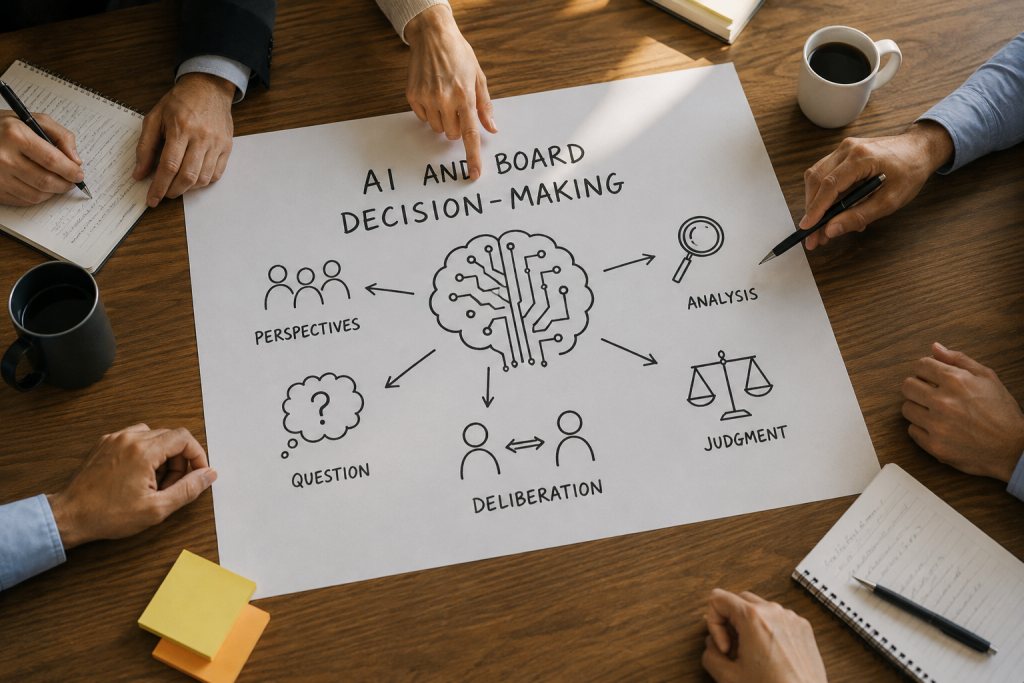
But something very different emerges when all directors rely on the same tool, trained on similar patterns, fed with the same documentation and generating similarly structured syntheses. Even if each director maintains strong critical capabilities, something more subtle begins to emerge: a gradual homogenisation of interpretative frameworks. Not because everyone thinks alike, but because everyone starts observing reality through increasingly similar cognitive structures.
This is where the classic groupthink described by Janis gives way to something new. Janis focused on human dynamics of conformity and implicit social pressure within the group. What AI introduces is different: a form of cognitive convergence mediated not by social dynamics, but by a shared technological infrastructure for interpreting reality.
The empirical evidence for this is now substantial. The Artificial Hivemind paper (Best Paper Award at NeurIPS 2025, by researchers from the University of Washington, Stanford, CMU and the Allen Institute for AI) analysed 26,000 real-world user queries across more than 70 language models. Its findings are striking: despite significant differences in architecture, training and scale, AI models exhibit pronounced intra-model repetition and inter-model convergence, generating strikingly similar outputs to the same prompts. When asked to write a metaphor about time, models across different companies and architectures independently converged on just two dominant images: time as a river, and time as a weaver. The authors warn that this convergence raises serious concerns about the long-term homogenisation of human thought through repeated exposure to similar outputs. A subsequent organisational analysis confirmed the implications from a leadership and work design perspective: the erosion of creative diversity in AI-assisted workflows, the potential amplification of groupthink in decision-making processes, and a fundamental misalignment between organisational needs for pluralistic solutions and what AI systems actually deliver.
A March 2026 paper from the University of Pennsylvania draws a further parallel with the 2008 financial crisis, where nearly every major economic model failed not because economists were unintelligent, but because they shared the same assumptions about market stability and risk. The mechanism is the same: not a failure of individual intelligence, but a failure of interpretive diversity.
The deeper risk may not be that AI makes us less intelligent individually, but that it gradually makes us interpret reality through increasingly similar cognitive structures.
Epistemic Independence as a Governance Asset
There is a concept from philosophy of knowledge that feels increasingly relevant here: epistemic independence (the capacity to form judgments through one’s own reasoning, rather than by adopting ready-made conclusions).
In the context of Boards, this has traditionally been understood as a structural question: independence from management, from controlling shareholders, from each other. But there is a deeper dimension we rarely discuss. Independence is not only a matter of position or affiliation. It is also, and perhaps more fundamentally, a matter of how each director actually constructs their understanding of a problem before the conversation begins.
When directors arrive having each consulted the same AI system, guided toward the same apparently salient questions, something subtle has already happened before anyone speaks. The diversity of entry points into the conversation (which is precisely what makes genuine deliberation possible) has been quietly reduced. Recent academic work describes this as epistemic monoculture: not the absence of diverse people around the table, but the gradual homogenisation of the interpretive lenses through which those people approach the same reality. Diversity in Board composition is not enough if the preparation processes that shape how each director enters the room have already quietly converged.
AI, Board deliberation and groupthinking: What Can Actually Be Done
The risk is real, but it is not inevitable. And responses exist at two levels.
At the individual level, the most important shift is one of intentionality. Each director can choose to use AI not as a shortcut to conclusions, but as a thinking partner that stress-tests their own reasoning before entering the room (asking it to construct the strongest counterargument to their emerging view, to surface assumptions they may not have questioned, or to articulate how a sceptical stakeholder might read the same situation differently). For practical ways to start doing this without waiting for formal board adoption, see How Directors Can Start Using AI Before Their Boards Officially Adopt It. Awareness of this dynamic is itself a form of governance: if every director is using the same tool, fed with the same documents, the diversity of entry points into a conversation may have already narrowed before anyone speaks.
At the organisational level, the research above points to several concrete responses:
• Deliberate tool diversity. (Using different AI systems or different prompting approaches in preparation, rather than converging on a single tool. The Artificial Hivemind research specifically notes that even model ensembles may not yield true diversity when their constituents share overlapping training priors, so variety of approach matters as much as variety of tool.)
• Structured devil’s advocate roles. (Formally assigning a director or using an AI system itself to construct the strongest counterargument before a decision is reached (a mechanism Janis originally proposed and one that AI can now help operationalise more consistently).)
• AI literacy for directors. (Not technical training, but deliberate reflection on how AI shapes the framing of information and what that means for independent judgment, including awareness that models from different companies may still converge on the same outputs.)
• Naming the risk. (Simply discussing how AI is being used in individual preparation can itself shift behaviour. Awareness is the first governance intervention.)
Paradoxically, this is also how AI can become a genuine antidote to the groupthink it risks creating. The same tool that homogenises interpretation when used passively can, when used with intentionality, protect cognitive diversity. A recent Harvard Business Review article argues precisely this: that AI may significantly improve decision quality in complex environments if used to surface alternative perspectives and help individuals process information more thoughtfully (before, not during, the moment of collective convergence). For a broader look at how boards are already putting this into practice, see The AI-Augmented Boardroom.
The Governance Question Beneath the Technology
This is, ultimately, the most important question. Not whether Boards will use artificial intelligence (they almost certainly will) but whether they will use it in ways that deepen collective thinking or in ways that simply make alignment faster and easier.
The difference between augmented governance and impoverished governance will probably depend less on the sophistication of the technology itself than on our ability to continue cultivating those things no artificial intelligence can fully replace: human judgment, the capacity to sustain difficult conversations, cognitive diversity, and the courage to think independently even when convergence feels more comfortable, faster and apparently more efficient.
Further Reading
• Irving Janis — Groupthink (Wikipedia)
• Groupthink — Research Starter (EBSCO)
• Decision-Making by Consensus Doesn’t Work in the AI Era (HBR, April 2026)
• How AI Can Help Tackle Collective Decision-Making (HBR, August 2025)
• AI, Epistemic Independence and Collective Decision-Making (PhilPapers)
• The Future of AI is Many, Not One — Epistemic Monoculture (University of Pennsylvania, March 2026)
• The Thinking Board in the Age of AI (Board Foundation, November 2025)