A second reflection on what remains uniquely human, built around the four capacities most worth protecting in the age of AI.
In an earlier reflection, I described the afternoon by Lake Atitlán when I first used AI and asked a friend the question that has stayed with me ever since: if this is what AI can do today, what will remain uniquely human?
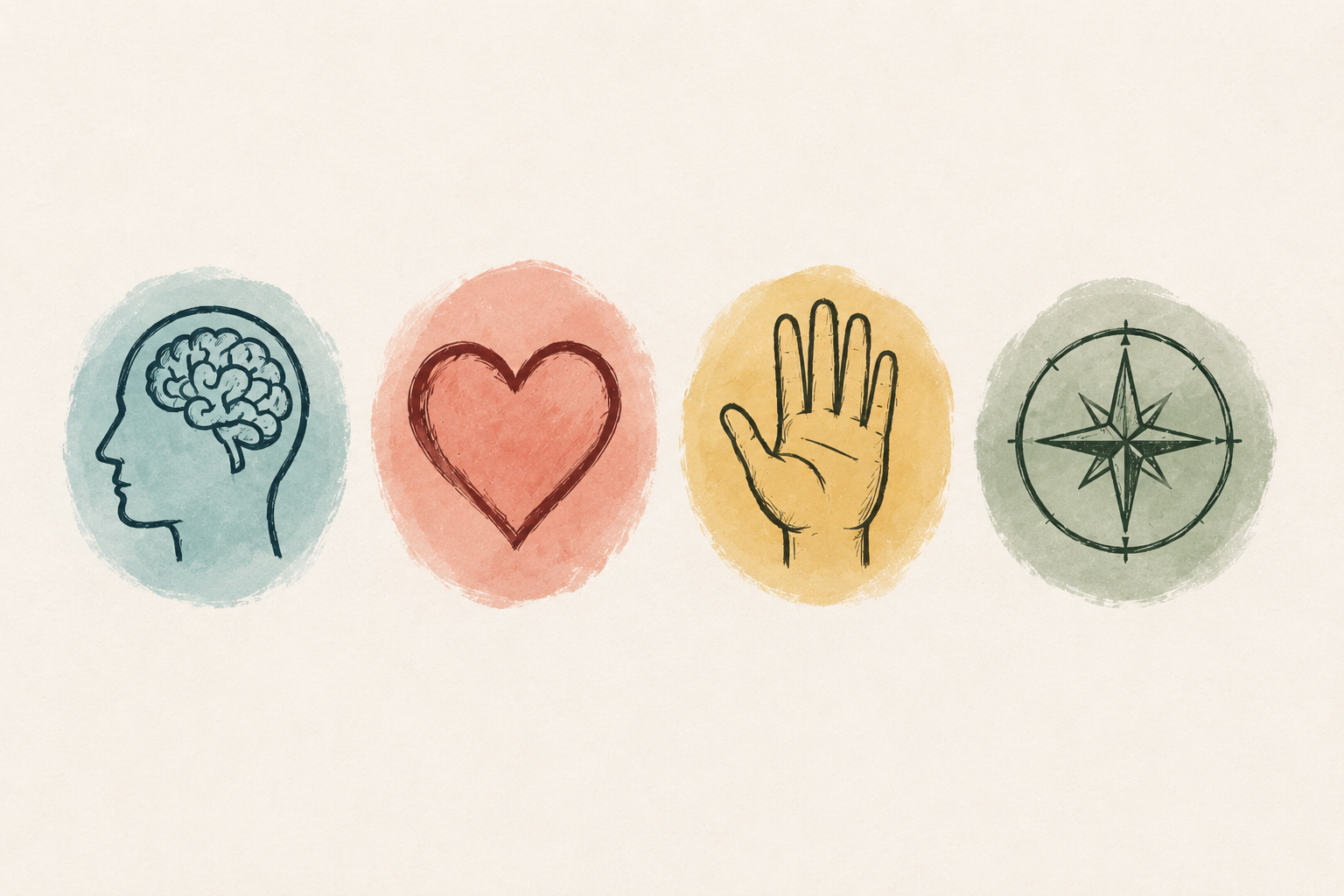
In that reflection, I suggested four capacities that may become even more important in the age of AI: Head, Heart, Hands and Conscience. Since then, I have found myself returning to them again and again, testing them against each new advance in AI and asking a simple question: are these truly the qualities most worth protecting?
That afternoon I reached for a few quick answers. What I did not expect was how soon each of them would be tested, and how the testing would teach me something I had missed. The more I watched AI close the gaps I thought were uncloseable, the more I realised I had been asking the wrong question. The question was never what AI cannot do. It was what is ours to do, regardless of what AI can do alongside us.
Over time, that question resolved into four capacities. I have come to think of them as Head, Heart, Hands and Conscience, and they are the ones I believe are most worth protecting, precisely because they are the ones a powerful tool can quietly erode if we are not paying attention.
The Trap of Defining Ourselves by What Machines Cannot Do
There is a comfort in listing the things AI cannot do. It reassures us. It draws a line and places us safely on the human side of it. But it is a fragile strategy, because the line keeps moving. Each time a system learns to recognise an emotion, hold a longer argument or write something that moves us, the ground we were standing on shifts.
If our sense of being human depends on staying one step ahead of a machine, we have already surrendered the more important question. We have let the technology set the terms. The four capacities below are not things AI cannot touch. Some it imitates remarkably well. They are the things that are diminished in us when we stop exercising them ourselves.
Head: The Judgement You Form by Thinking First
A machine can hand you a conclusion in seconds. Well structured, articulate, often good. And that is precisely the risk. Judgement is not the answer you arrive at; it is what forms in you while you struggle toward it. The hypotheses you test, the objections you anticipate, the discomfort of holding a half-formed idea until it becomes clear.
If you reach for the tool before you have done any of your own thinking, you get the output without the formation. Do it once and nothing is lost. Do it as a habit and something quietly atrophies: the capacity to form a position of your own. The head remains uniquely ours not because we compute better, but because the slow, effortful work of thinking is what builds the judgement we then bring to everything else. The tool should extend that judgement, never replace the process that creates it.
Heart: We Are Social and Emotional Beings
We are not solitary reasoners. We are social and emotional beings, and much of what matters most in a life happens between people: empathy, trust, belonging, the willingness to be affected by someone else’s reality. A machine can generate words that sound caring. It can even name an emotion accurately. But it does not need anyone, and it has nothing at stake in the relationship.
Trust is the clearest example. Real trust is built through history, vulnerability and the small proofs that someone will show up when it costs them something. It cannot be simulated, because its whole value lies in the fact that a person chose to give it. The heart is uniquely human not because AI cannot mimic warmth, but because connection only means something between beings who can genuinely be moved by one another. That is something no system, however fluent, can offer.
Hands: Intuition, Practice and the Wisdom of Doing
Some knowing never passes through words. The negotiator who feels the room turn before anyone speaks. The clinician whose hands sense something is wrong before the test confirms it. The craftsman who knows when the wood is ready. This is embodied knowledge: intuition and presence, built up through years of doing, and it does not transfer cleanly into a model that has never had a body to learn from.
The founder of Schumacher College, Satish Kumar, has spent decades arguing that real education engages not only the head but also the heart and the hands. In his philosophy of “head, heart and hands,” the hands are not a lesser faculty; to learn by doing, to make something ourselves, to let experience accumulate a wisdom the intellect cannot reach on its own, is part of what forms a whole human being. Most institutions, he warns, educate only the head, as though students arrived without bodies at all.
That warning lands differently in the age of AI. If we let our tools do more and more of the making and the sensing, we risk becoming exactly the disembodied minds he cautioned against, fluent in answers we never had to work for. Presence and intuition are not inefficiencies to be optimised away. They are a form of knowing that experience earns, and only experience can provide.
Conscience: Deciding in Your Own Name
A system can recommend a decision. It can weigh options faster than we can and lay out consequences with a clarity we rarely manage alone. But it cannot answer for the decision. It cannot stand before the people affected and own what was chosen.
This is the heart of moral agency: not calculating the right answer, but being willing to be held to account for it, and to hold ourselves to account. When a leader makes a hard call, the deliberation may be shared with a machine, but the answerability is not. It rests with a person who decides in their own name and lives with the consequences. Responsibility is the one thing that cannot be delegated without disappearing. The more powerful our tools become, the more the world needs people willing to remain answerable for what is done with them.
What This Means for How We Lead
Head, Heart, Hands and Conscience are not a wall between us and the machines. They are the capacities most worth cultivating, precisely because they are the ones a powerful tool can erode without anyone deciding that they should. The task ahead is not to compete with AI. It is to use it in a way that strengthens these four rather than hollowing them out, and to build organisations and institutions that protect the space for them.
This is harder than it sounds. The pull of efficiency is strong, and it is tempting to hand over not just the calculation but the caring, not just the analysis but the answerability. The leaders and institutions that will matter most in the coming years, I suspect, are those that resist that temptation: those that use these remarkable tools to free human attention for what only humans can do, rather than to quietly replace it.
That conviction has been growing in me for some time, through the conversations I now host through AIRIS and through a longer piece of writing I have been working on, about what makes us human and why it matters more, not less, in this moment. I am not ready to say much about it yet. But it grew from the same question that found me by the lake, and in the coming weeks I look forward to sharing more.
For now, I will leave the question where it belongs: open.
Not what can AI not do, but what is ours to do well.
Perhaps the question is not whether AI will become more intelligent. Perhaps the real question is whether we will continue to cultivate the capacities that make us fully human: clear minds, open hearts, skilled hands and an awakened conscience.
The answer to that one is not waiting to be retrieved.
It is waiting to be lived.